Le silence dense
Tout dance et se meut avec grâce
dans un élan infini
le bon et le pire de sa race
répondent à la symphonie.

Le présent, le passé
mêlés à l'inconscient
font danser les pensées
avec les émotions.

Les pèlerins, les soldats en guerre
le sang, la lumière, le son
chaque atome sur terre, même l'éther
suivent le rythme à leur façon.

Lune, mer, et monts érigés
tous dansent à l'unisson
et toi qui me lis figé
ça danse dans ton sang.
Dense silence. everything dances and moves with grace/ in an infinite flow/ the good and the worst of its race/ answer the symphony./the present, the past/ together with the unconscious/ make the thoughts dance/ along with emotions. / the pilgrims, the soldiers at war/ the blood, the light, the sound/ every atom on earth, even the ether/ follows the rhythm in its own way./ Moon, sea, and mounts erected/ all dance in tune/ and you who read me frozen/ it dances in your blood.
\ Mohssine Arraji was born in Casablanca and currently lives in Marrakech. His work’s field is children psychiatry, but he is also an extreme sports athlete, and he writes poetry in his spare time \
Dance
Just as the function of f(x)=e^x tends toward infinity,
my body, mind, and imagination tend toward dance.
Nothing in this world has ever had quite the same healing powers over my psyche as rhythmic movement set to music. This is what I mean when I say, ‘dance is my therapy’. Or in the words of a random neuroscientist whose article I found on Google Scholar:
“The combination of movement and music during dance results in a distinct state characterized by acutely heightened pleasure, which is of potential interest for the use of dance in therapeutic settings.” (Bernardi et al. 2017)
I’ve been dancing for over 20 years now. That is to say, I’ve been taking lessons in styles of dance spanning ballet, afro fusion, dancehall, house, hip-hop, vogue, or pole dance, for over 20 years. Dancing in the sense of moving my limbs in any other manner than functionally, jigging and jiving around, I surely have been doing ever since I could stand upright. I did not realize, however, how much this is part of my personality, until one day, for the nth time, my partner and I broke down how differently we perceive music.
Her focus lies heavily on the lyrics. What story are they telling? What hidden meanings or profound interpretations may be teased out from them upon your 18th listen? I, on the other hand, could listen to nonsensical gibberish, the lamest rhymes and kitschiest hyperbole, or indeed lyric-less music for hours on end, so long the beat satisfies me. Every now and then a line might stand out as especially good or especially bad, but I rarely find as deep of a connection with the music’s words as I do with its rhythms, melodies, and production.
That day, the why of it all finally hit me: I perceive music through my moving body. Or through how my mind envisions my body moving. A song is rousing when it compels me into motion. When it makes me tap my feet and bop my head. When I am left with no choice but to twirl and bounce and swing my arms around.
It goes so far that, while someone else might be playing little movies in their head, or thinking of scenarios accompanied by the music that enters their ears, I think in choreographies. How could the emotion of the song, the feeling behind its notes and harmonies, be extended and conveyed through my limbs? What intricacies in the instrumentation may be reflected in a kick of my heel or a sweep of my elbow? These routines may never materialize, and may not be particularly skillful either, but they form an essential part of why I place much more importance on musicality rather than lyricism.
That on its own, however, does not yet explain the uniquely therapeutic properties of dance.
I’ve never managed to enter a meditative state – I have yet to find sufficient patience to train for it. But dancing to specific genres of music might be the closest I have ever gotten.
And so, 2022 happened to be the year I discovered the ‘distinct state characterized by acutely heightened pleasure’ I enter when dancing specifically to electronic and techno music.
I used to think inane the idea of seeking out dark clubs filled with sweaty bodies, just to aggressively two-step to a repetitive beat. That was until, one serendipitous night, I found myself in a repurposed parking garage turned techno-bunker at the tail end of Barcelona’s largest music festival. I had wandered off on my own after enjoying a range of different sets, drawn in by thumping bass and ominous lighting emanating from the mouth of this cave.
Not quite knowing what to do with myself at the edges of the crowd, I started imitating the sequence of motion I saw repeated within most every single one of the bunker-attendees. A simple shifting of the weight, from left to right and back left again, over and over, like a relentless march ordered by the battle call toward oblivion.
And after overcoming the initial rigidity of my joints, carefully oiling all the seams where my creaky bones scraped up against each other, oblivion I did indeed find. The speakers thump too loudly to let the thoughts in your head take any coherent shape. Thus, you must accept the void and turn yourself over completely, to let every tune erode you, particle by particle, until you have melted into the sound.
Since that night, I continue to seek the same refuge from my own mind, as I flee both deeper within my body and simultaneously far beyond its physical boundaries. I am fully present in my vessel and observe how it moves instinctively to every beat, every note, and every chime. How the visceral sensation of dancing in harmony with the music spreads through me in euphoric prickles. And so, I have become my own keeper, as I rock myself into intense yet tranquil ecstasy. Letting the body, for once, be in complete control.
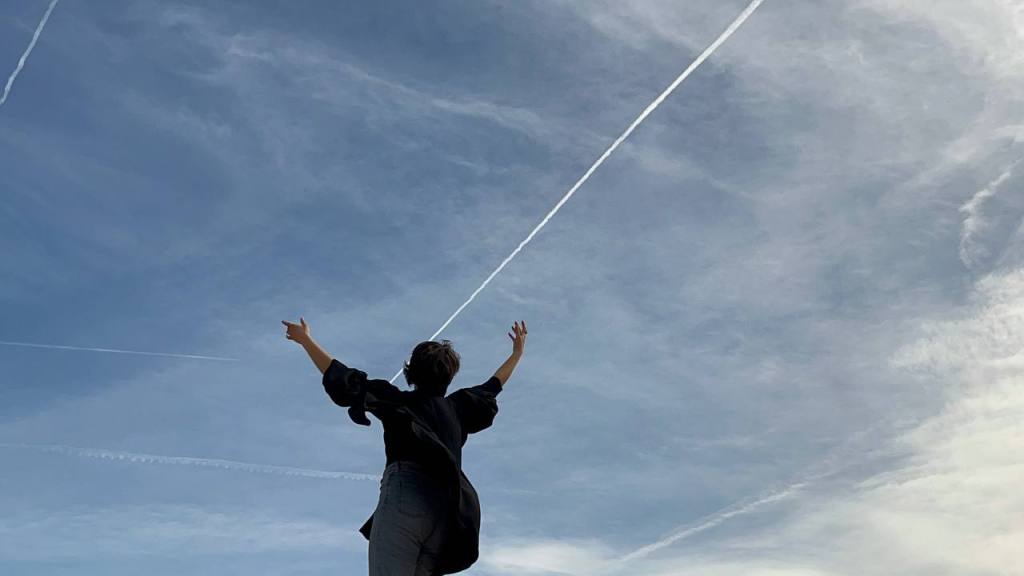
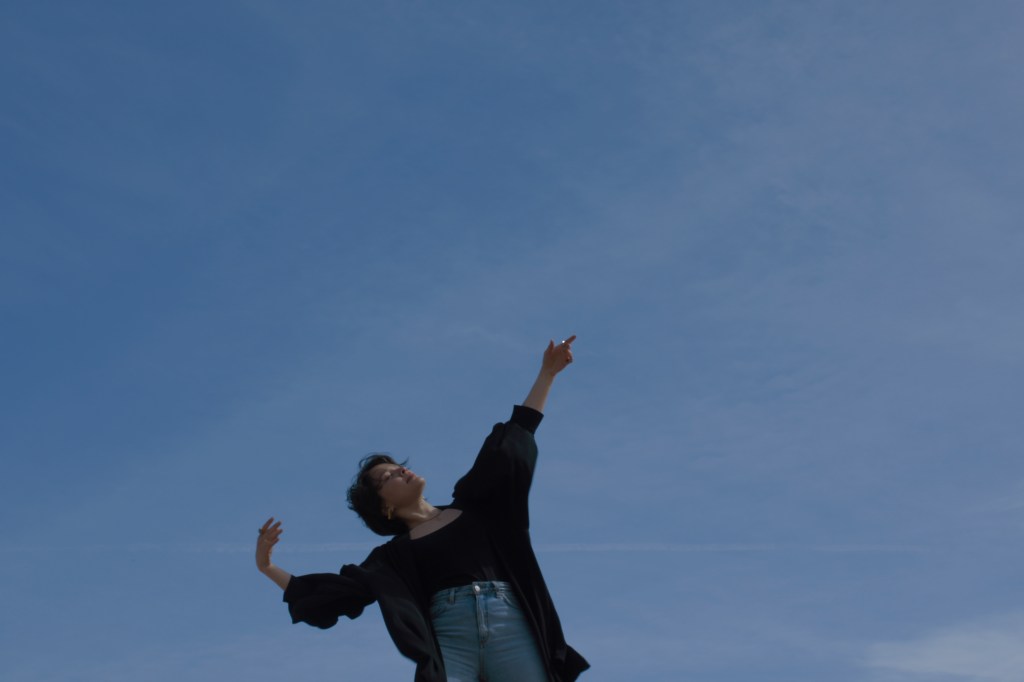
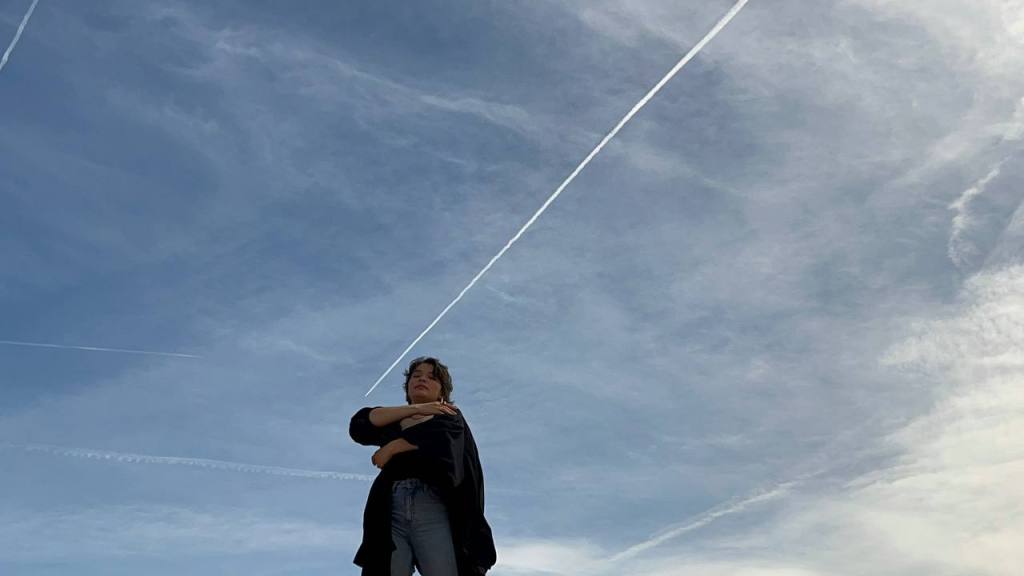
Image credit: Anastasiia Khalaimova
\ Sophie Eis is a sociologist and pharmacist by training, but she is a writer and a dancer exploring her artistic expression in her free time \
Sleeping movement
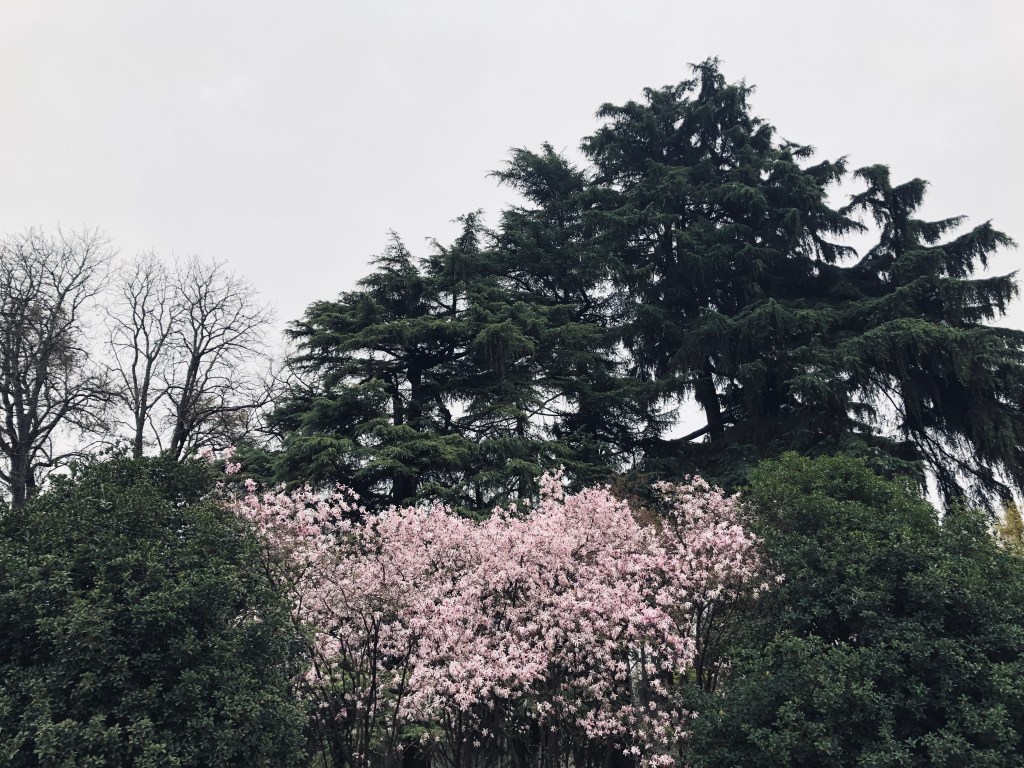
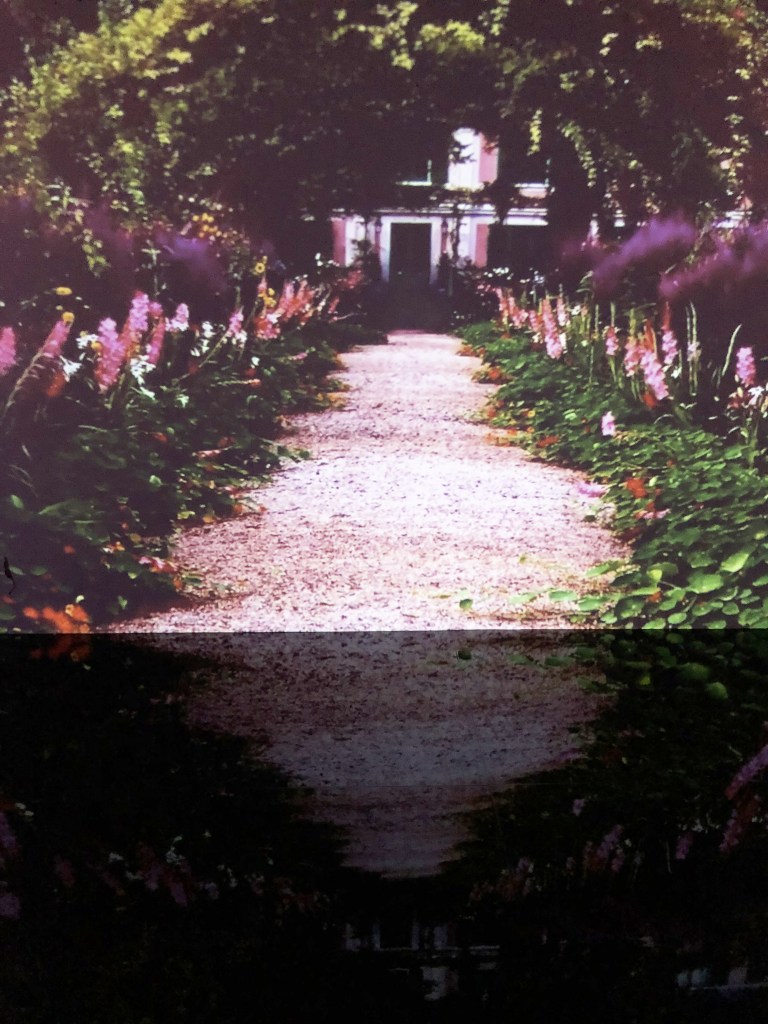
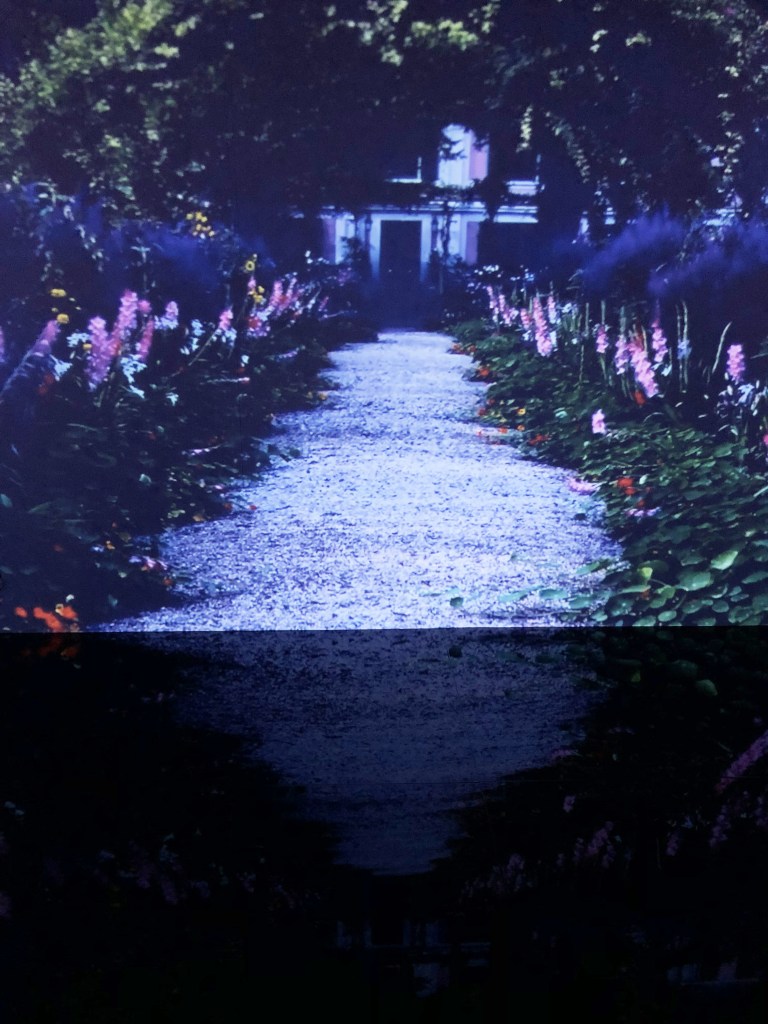
right, left, up, right, left, up, right, left, up, I go metres and you don’t realise it
\ Sarah Fournier studied at Universität für Musik und darstellende Kunst Wien.
She now lives in Paris where she teaches music and simultaneously runs a small
performance art space. Nature is her first source of inspiration in which she finds everything she needs \
The Garden of Earthly Delights
A body is made for dancing
under the tender pompons of pink
bubbles
are getting into my feet
I’m levitating

Sun is pouring gold
over our heads
we have halos
of copper light

My skin is a mirror
that perspires energy
Gravity grasps my heels
and this is how the third act ends
\ Patrycja Holuk was born in Kalisz (Poland) at 14 Patrycja moved to Italy with her family. After working as a translator, promoter, gallery assistant and graphic designer, she’s currently writing scripts, working as a photographer and art director. You’ll never know what she’s up to next \
Reflection, New World, The Kick, Abyss, Dragon
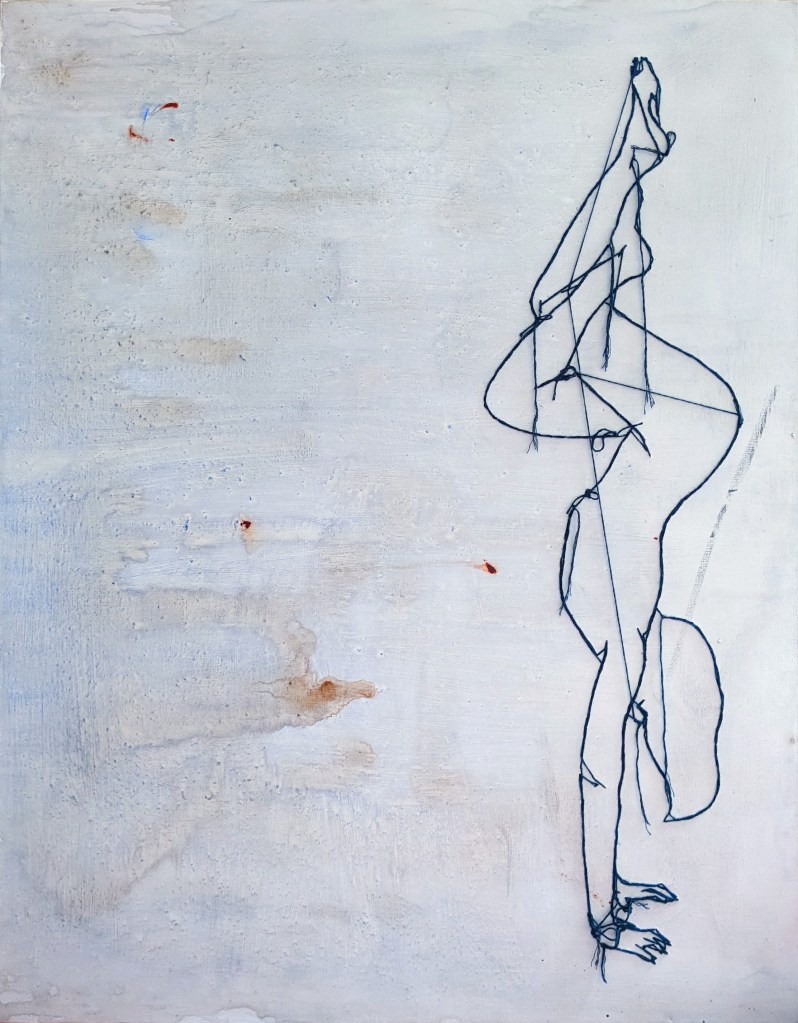
Artwork 1
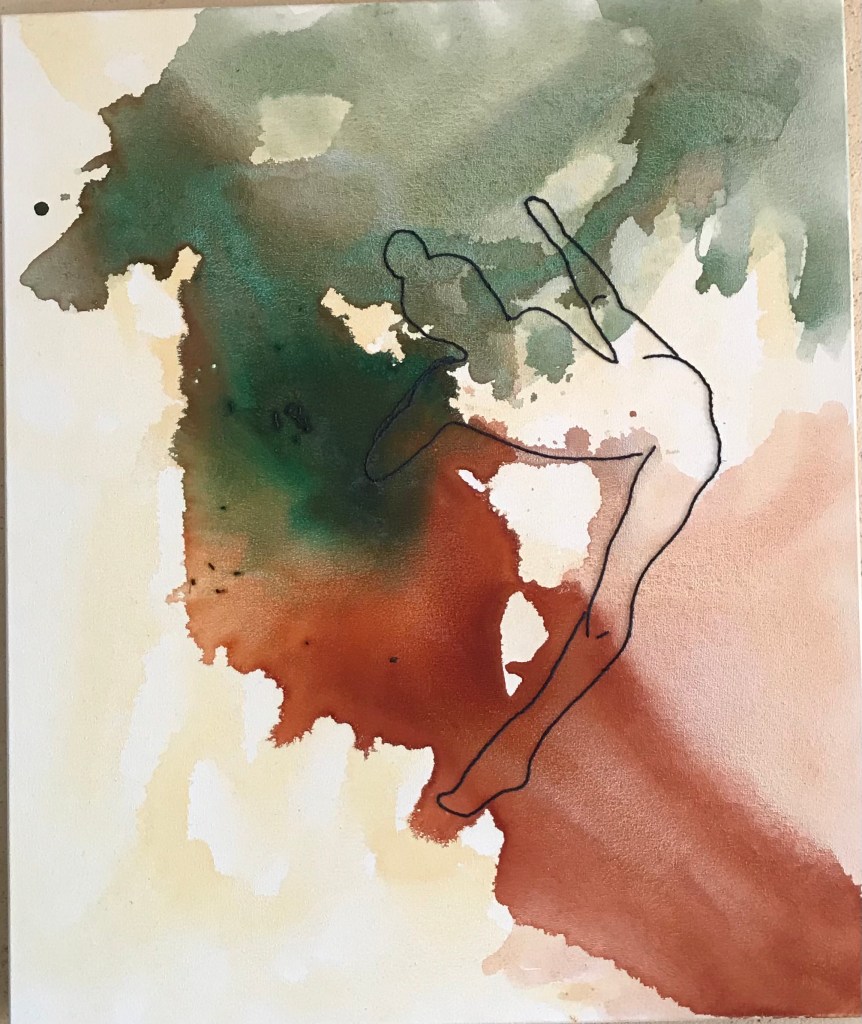
Title: Reflection
(2023, Mixed, acrylic paint, bamboo yarn, Cotton surface, 80X100 cm)
The painting is made of the left overs of us. It is painted on a rescuedcanvas, using the leftover water from another painting (Abyss). The figure is sewnonto the back of the canvas presenting what is meant to be hidden. The painting, while being very light, is also left with a dirty textured feeling, reflecting the reality of the internal human experience. When we share who we are inside, it is not alwaysclean, but it is always beautiful.
Artwork 2
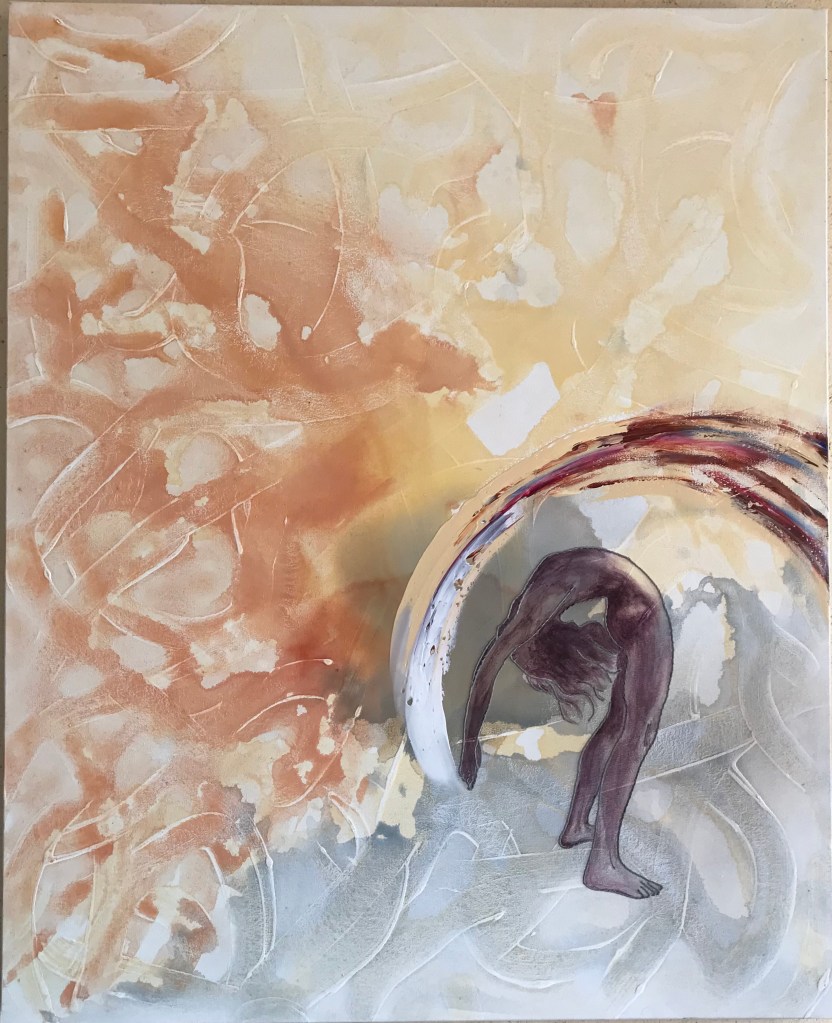
Title: New World
(2022, Mixed, Acrlic paint, Bamboo yarn, Cotton surface, 80X100 cm)
This painting is about opening yourself up to the possibilities and what you can bring into your life through the freedom of movement and acceptance of self.
Artwork 3
Title: The Kick
(2022, Mixed, Acrylic Paint, Bamboo yarn, Black Tea Leaves, Cotton surface, 40X60 cm)
This painting is created from freedom in nature. Allowing one’s self to expand in all directions.
Artwork 4
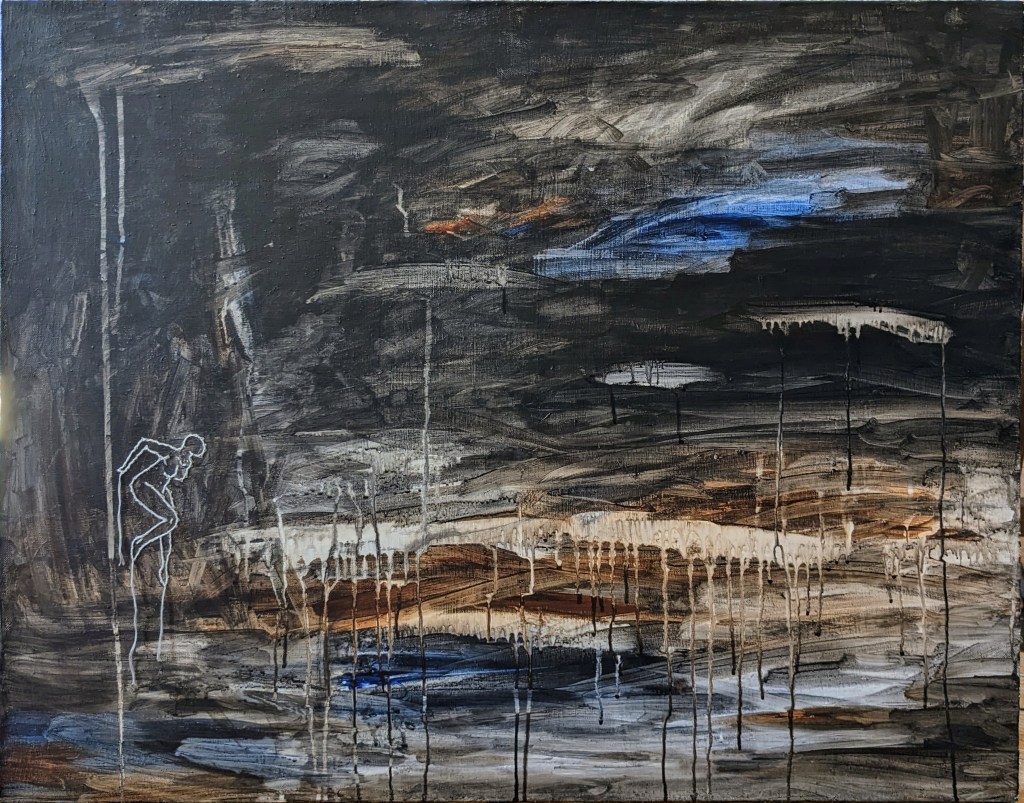
Title: Abyss
(2023, Mixed, Acrylic Paint, Bamboo yarn, Linen surface, 100X80cm)
This painting was created after a night of protests turned nearly to riots. When this painting was started there was still the smell of burning trash in the air and the tension that you can’t do anything about it. It is always a dance between what you feel, and what you feel like you can do.
Artwork 5
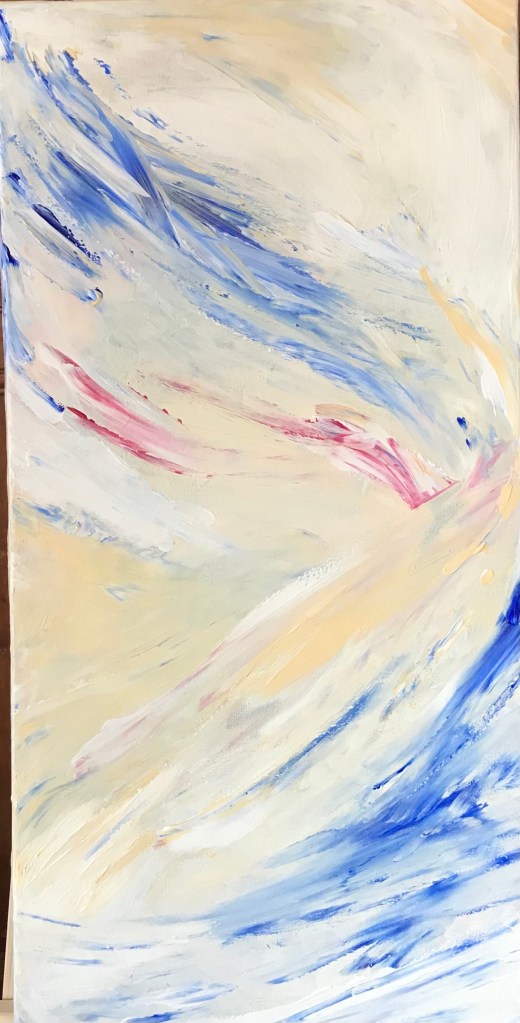
Title: The Dragon
(2023, Acrylic Paint, Cotton surface, 40X80cm)
The process of making this painting was a dance. The freedom of movement and the joy of spirit that I felt as I made it translated onto the canvas.
\ Julia Langer is an American artist living in France. Julia is both a performer and visual artist fascinated with movement and energy. She aims to incorporate the grace and movement of performers onto the canvas in a fluid and tactile way. A work about duality; freedom, and control. The paintings themselves are very freely made, bugs flying, tea spilling, mannequins falling, are all welcome. The figure is then carefully sewn into the canvas highlighting the contrast of a human body moving in utter control. Julia hopes to inspire creativity and movement in the viewers \
Slipping
It’s a strange sensation
To slip into your body
Deep at night
When our eyes are shut
And all edges get blurry

My fingers start to feel out your form
From within
Filling you in length and width

Slightly compressed
Pushing into alien boundaries
That I know only too well from the other side

With every wiggle, every stretch
I adapt
Till I flow into you like into a mold

I feel your heart
Your bad knee
Your skin folds differently than mine

I move to unheard rhythms
Suddenly, it comes easy
A vibration

I dance your body
It dances me
New movements
Altered sensations

We evolve into something new
Neither you nor I
A creature of movement, a wave of us
Till
I slip out
\ Luisa Bergader develops strategic narratives and inspiring perspectives for
fluid, free and entangled ways of being. Her collaborations explore queer
thinking in organisational transformation processes, community-centred
hospitalities as well as pleasure activism in digital spaces. For this, she
partners with empathic companies, academic institutions, futurists and other
creative souls in diverse projects. Practices of Deep Listening, Radical
Softness and Relationship Anarchy inform her writing, thinking and doing. Two messages from her: Stay soft & keep on shifting \
On the concept of dance in the aesthetic field
Crossbreeding of arts in sixties
The relationship between dance and contemporary art has its roots between sixties and seventies in New York. In those years the New Amsterdam became the meeting point for all those artistic practices that were coming to form. The encounter of different artists allowed a revolution against the applied and dogmatized sectoral approach. Creators needed to experiment in order to make a new reality and in this sense the transgression of limits, as well as the subversion of the rules established up to that moment, were the tools that best could respond to this intent.
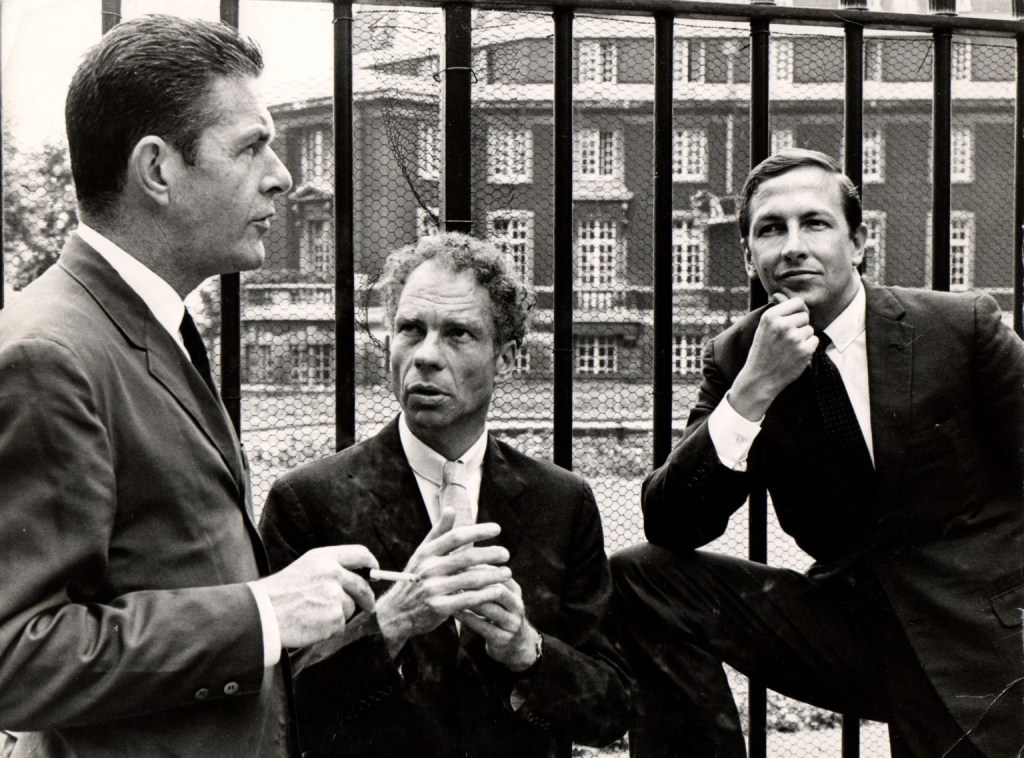
In this transformative landscape was born the collaboration between Merce Cunningham and Robert Rauschenberg. We can consider them as the pioneer of this double gaze, that over time has been then replicated, until now that Is becoming almost a constant in contemporary artistic work. Actually, their choreographies became out-and-out works of art. As their dancing bodies have become installations, likewise performance art included itself dance as key part of the process. Therefore, it is a bilateral relationship that is still supported today.
On Merce Cunnigham
(Imm.01)
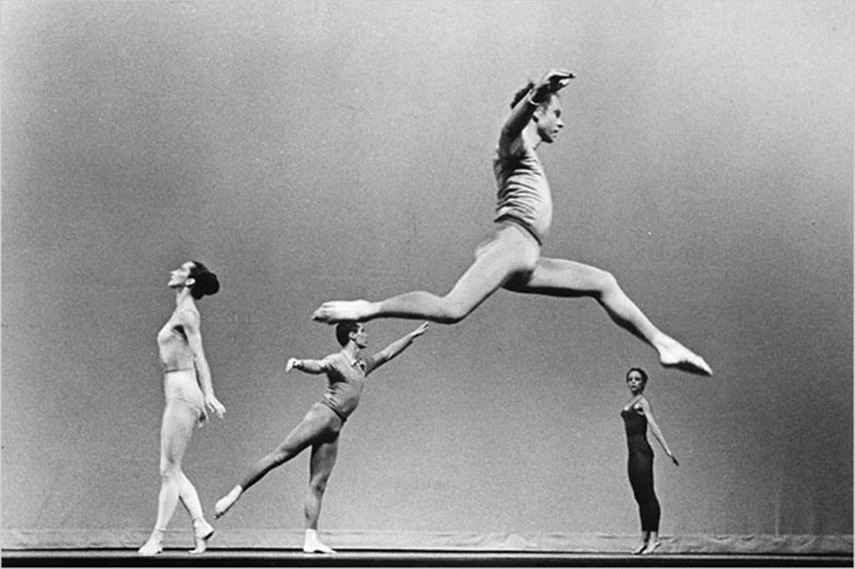
Merce Cunningham (1919-2009), American dancer and choreographer, is one of the few true revolutionaries in the history of dance, a symbolic landmark in the avant-garde in all arts. The American dancer conceived the Change Method, that is the mode he used to free his imagination from stereotypes. As a result of his revolutionary idea, he considered dance as a non-linear activity consisting of events that occur on stage without any logic, in order to favour the movement itself. Cunningham was in favor of the simultaneity of artistic languages, that is the reason why it is considered as the precursor of collaborative events and the cultural hybridization that we see today.
Collaborative theatre event
(Imm.02)
In 1952 Cunningham faced the world of contemporary art. Thanks to the collaboration with the American composer John Cage (1912-1992), they did the first experimentation of the hybridization of the arts, that is the multimedia performance Untitled Event. Now known as Theatre Piece No. 1, the performance took place in the refectory of the Black Mountain college, and we could consider it the first happening of history of art. Even if Cunningham was not interested on see what happens, rather than an interdisciplinary of the arts.
(Imm.03)
On the ceiling of the dining hall, there were Rauschenberg’s White Paintings, that were monochrome paintings reflecting the surrounding environment. The spectators are divided into four triangles of chairs, whose vertices head towards the empty center of the room. In 45 minutes, the duration of the performance, Cunningham improvised a dance around the audience; Cage did a lecture on the German mystic Maest Eckhart, standing outside the audience; Rauschenberg casted images on the walls; Mary Caroline Richards declaimed verses; Charles Olson, sitting in the audience, got up to say jokes and David Tudor played Cage’s Water Music on the piano.
The performance, or rather the collaborative theatre event, is a turning point in the history of art. As Cunningham said any movement is dance and there are moments during a choreography in which a movement is so natural and not formalized or, on the contrary, so particular and eccentric that it does not seem like dance at all. He is just interested in the movement itself in order to take a sense of liberation.
So, it goes without saying it is not a coincidence that art and dance have found a common point, a way to speak about freedom without saying a word, but thanks to the combination of universal languages.

\ Vittoria Mascellaro after she received a degree in Philosophy at Università degli Studi in Milan, she attended a two-year specialisation in Visual Arts and Curatorial Studies in NABA. She is currently cultrice della materia Sociology of Art at Accademia di Belle Arti in Catania and she is curating the exhibition project The Rights from Future Generations – A Perspective on (A)rt and (I)nnovation in Monza \
We
We dance to create energy, to create life. Who is we'?
We go against staticity, embracing the vital engine of transformation and progress.
Adding fragments to the whole.
We die and are reborn each time.

What moves us?
How do we move the world?
Interpret: Giulia Romitelli
Video filmed by: Marcelle Gressier
Music: Laurie Anderson – O Superman
Filmed in Matosinhos, Portugal, 2021
\ Giulia Romitelli, with a background in Contemporary Dance and Architecture, is involved in performing and visual arts. Exploring the connections between body and space, her research questions how movement adapts and changes in relation to different and various environments. The core of her creative processes is the exploration of the interaction among volumes, textures, lights, shadows and bodies \
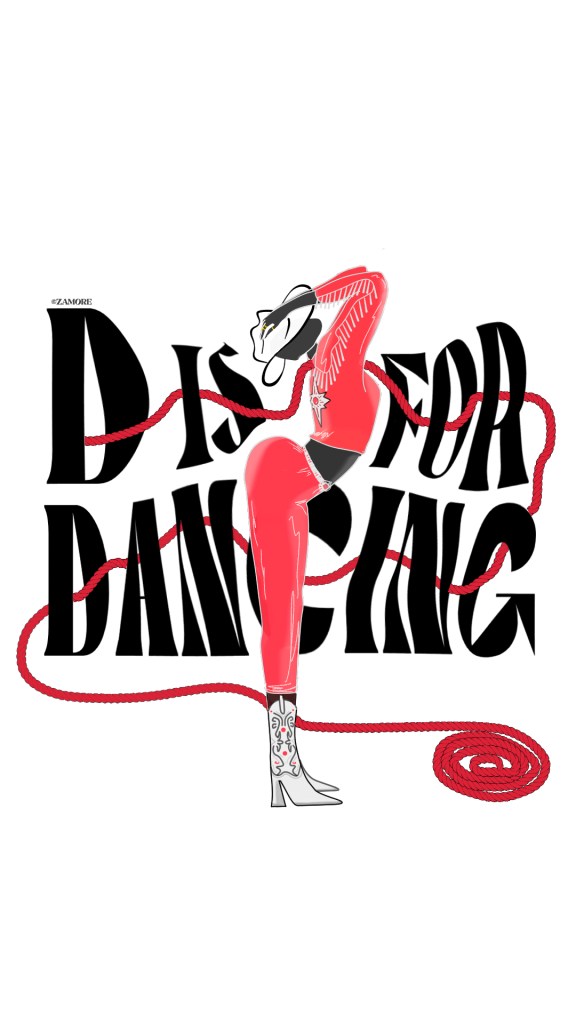
D is for dancing
Dancing is surrendering to indulgence
I dance to feel funky, alternative, jazzy, bohemian, etc.
I dance to a hopeful intro, to then surf in-between waves that carry me to my south pole. My unconscious. Without masks, needs or expectations.
I dance to connect with a stranger’s look and mirror the infinite energy of this world; the empathy that makes us humans.
I dance to witness that moment when you catch someone, seeing you catch the same vibe as them, and then turn into a collective of believers.
We believe we deserve this dance.
We believe we got this.
We believe we can do this.
We let ourselves be wrapped in a song; be absorbed by a song; be consumed by a song. Be reborn with dance.
We become life in another shape or form.
\ Jaqueline Zamora is a Mexican storyteller, now based in the Netherlands.
Here is where she encountered her love for the visual narratives, 2 years ago. From music videos, to poetry books, to illustrations and animations, Jaqueline considers herself a Jack of A Trades. The only aim being, to explore as many ways to communicate her stories \
 alfabèto